

Damp and Mould in Dublin Homes Causes and Fixes Guide
Damp and mould are, without exaggeration, one of the most persistent headaches for homeowners across Dublin. Whether you’re living in a Victorian terrace in Rathmines, a 1970s semi-detached in Clontarf, or a more recently built apartment, the chances are you’ve spotted that familiar dark patch creeping along a wall or ceiling at some point. And if you haven’t dealt with it properly, it’s probably come back.
This guide is designed to walk you through exactly why damp and mould are so common in Dublin homes, what causes them, what they can do to your health and your property, and most importantly, how to actually fix them for good rather than just painting over the problem.
Key Takeaways
- Dublin’s damp climate and older homes make mould especially common.
- Mould usually signals an underlying moisture problem, not just a surface issue.
- Condensation, leaks, and rising damp are the main causes to check first.
- Mould can harm health and damage the building if ignored.
- Lasting fixes start with a professional damp survey and root-cause treatment.
Why Damp and Mould Are So Common in Dublin Homes
Dublin’s Climate, Older Housing, and Poor Ventilation
Dublin sits on the eastern coast of Ireland, a country that’s essentially famous for its rain. The city receives an average of around 730mm of rainfall per year, and even on dry days, the air tends to be heavy with moisture. This kind of persistently high ambient humidity creates the perfect baseline conditions for damp to develop inside homes, particularly when ventilation isn’t up to scratch.
Older housing stock makes this problem significantly worse. A huge proportion of Dublin’s residential properties were built before modern building regulations came into force, meaning they weren’t designed with moisture management in mind. Solid brick walls, single-glazed windows, and minimal roof insulation were standard practice for decades, and those homes are now struggling to cope with the demands of modern living.
Add to that the way people actually use their homes today. We cook more, shower more, dry clothes indoors during the winter months, and tend to keep windows shut to conserve heat. All of that moisture has to go somewhere, and in a poorly ventilated home, it ends up on your walls and ceilings.

How Damp Becomes Mould in the First Place
Understanding the relationship between damp and mould is genuinely useful, because a lot of homeowners treat them as the same problem when they’re actually two different stages of the same process.
Damp is the moisture problem. Mould is the biological consequence.
Mould is a fungus that thrives in damp environments. It reproduces through microscopic spores that are constantly floating through the air in any home. Under normal, dry conditions, those spores don’t have what they need to settle and grow. But introduce a persistently damp surface, whether that’s a cold wall, a wet window frame, or a patch of plaster that’s absorbed water from a leak, and you’ve given those spores exactly what they’re looking for.
The process can happen surprisingly quickly. In the right conditions, mould can begin to establish itself on a surface within 24 to 48 hours of it becoming damp. That’s why a slow leak left unaddressed, or a bathroom wall that never quite dries out, can turn into a visible mould problem in a matter of days. By the time you can see it, it’s already been there for a while.
The Main Causes of Damp and Mould in Dublin Properties
Condensation, Leaks, and Rising Damp
There are three primary types of damp that affect Dublin homes, and it’s worth knowing the difference because the fix for each one is quite different.
Condensation is by far the most common. It happens when warm, moisture-laden air meets a cold surface and the water vapour condenses into liquid. You see it on windows every morning in winter, but it also happens on walls, particularly external walls that aren’t well insulated. Bathrooms and kitchens are the usual suspects, but condensation can affect any room in the house.
Penetrating damp occurs when water gets in from outside, usually through a defect in the building fabric. Common culprits include:
- Cracked or missing pointing in brickwork
- Damaged roof tiles or flashing
- Faulty gutters or downpipes that allow water to run down external walls
- Poorly sealed window or door frames
Rising damp is less common but more serious. It happens when groundwater travels upward through a wall via capillary action, typically because the damp proof course (DPC) has failed or was never installed in the first place. It tends to produce a distinctive tide mark on lower sections of walls and is more prevalent in older Dublin properties, particularly those built before the 1920s.
Misidentifying which type of damp you’re dealing with is one of the main reasons many homeowners spend thousands on ineffective treatments. Treating condensation with a chemical DPC injection, for example, will do absolutely nothing to solve the problem.

Other Handyman Services We Can Help With
Not every job around the home fits into one category. If you have a few different jobs that need doing, Local Handyman Home can often take care of several during the same visit.
We provide practical handyman services throughout North County Dublin and surrounding North Dublin areas, including:
- TV Wall Mounting & Shelving – TV mounting, floating shelves and other wall-mounted fittings.
- Flat Pack & IKEA Furniture Assembly – Assemble wardrobes, beds, desks, shelving and other furniture.
- Painting & Decorating – Smaller painting, decorating and room refresh jobs.
- Carpentry, Shelving & Door Repairs – Shelving, door adjustments, handles, hinges and household carpentry.
- Curtain Poles, Blinds & Picture Hanging – Curtain poles, blinds, mirrors, pictures and wall-mounted items.
- Small Plumbing & General Repairs – Smaller plumbing jobs and general household repairs.
- Silicone, Grouting & Bathroom Sealing – Bathroom silicone, sealing and smaller grouting jobs.
- Landlord & Property Maintenance – Practical repairs, maintenance and preparation work for rental properties.
Have a List of Jobs?
You don’t need to work out which service each job belongs to. Just send us a list of what needs doing, along with a few photos if helpful, and we’ll let you know how we can help.
One visit, several jobs — simple, practical handyman help from a local service you can rely on.
Outdated Insulation and Ventilation in Homes Built Before 2000
Homes built before 2000 in Dublin present a particular challenge when it comes to damp and mould. Building regulations in Ireland have been progressively tightened since the 1990s, with significant updates to insulation and ventilation requirements introduced over the years. Properties built before these changes came into effect were simply not designed to meet modern standards.
Cavity wall insulation in older homes, where it exists at all, may have degraded over time or been improperly installed. Degraded insulation can actually trap moisture within the wall cavity, creating ideal conditions for damp to penetrate into the interior. Solid-wall Victorian and Edwardian properties have no cavity at all, making them particularly vulnerable to penetrating damp.
Ventilation is the other major issue. Older homes relied on natural ventilation through gaps, chimneys, and draughty windows. As homeowners have improved the energy efficiency of these properties, fitting double glazing and draught-proofing, they’ve inadvertently sealed up those natural ventilation pathways. The result is a much tighter building envelope with nowhere near enough air circulation to manage the moisture generated by daily living.
The practical impact of this is significant. A family of four generates roughly 10 to 15 litres of moisture per day through cooking, bathing, breathing, and drying clothes. Without adequate ventilation, that moisture has nowhere to go but onto your walls.
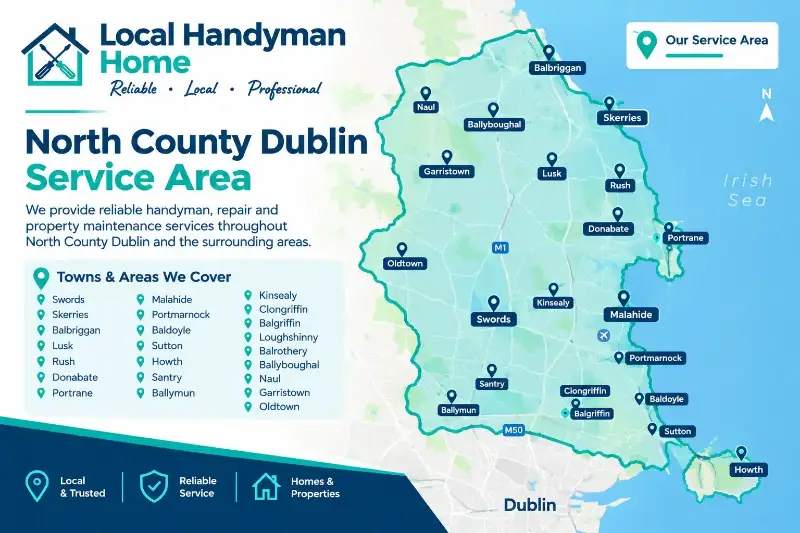
Areas We Cover in North Dublin
Local Handyman Home is based in Skerries, Co. Dublin, and covers North County Dublin and nearby areas. Not sure if we cover your location? Get in touch and tell us where the job is.
North County Dublin
Dublin 15 & Northside
Nearby Areas We Also Cover
- Portmarnock
- Baldoyle
- Sutton
- Kinsealy
- Balgriffin
- Clongriffin
- Raheny
- Artane
- Donaghmede
Don’t see your area? Tell us your town and the job when you contact us, and we’ll let you know whether we can help.
Contact Us Today. Get Your Free Quote Today.
Health Risks and Property Damage from Mould
Allergies, Respiratory Issues, and Vulnerable Occupants
Mould is not just an aesthetic problem, and this point really can’t be overstated. According to the EPA, mould spores can cause a range of health issues, with allergic reactions being among the most common. Symptoms can include sneezing, runny nose, red eyes, and skin rashes, all of which can be easily mistaken for hay fever or a persistent cold, especially during the winter months when people are spending more time indoors.
For people with asthma, the situation can be considerably more serious. Mould spores are a well-documented asthma trigger, and prolonged exposure in a mould-affected home can increase the frequency and severity of asthma attacks. Children, the elderly, and anyone with a compromised immune system are particularly vulnerable.
The health impacts are not always dramatic or immediately obvious. Many people living in mould-affected homes report:
- Persistent fatigue that doesn’t resolve with rest
- Recurring respiratory infections through the winter
- Chronic sinus congestion
- Skin irritation or unexplained rashes
- Worsening of existing conditions like eczema
If you or anyone in your household is experiencing these kinds of symptoms and you’ve noticed any signs of damp or mould in your home, it’s worth taking the connection seriously. Your local health department can provide guidance on mould-related health concerns if you’re unsure where to start.

The Best Fixes for Damp and Mould in Dublin Homes
Professional Damp Surveys and Diagnosing the Root Cause
The single most important step in fixing a damp and mould problem is getting the diagnosis right. This sounds straightforward, but it’s where a lot of homeowners go wrong, often by attempting to identify the cause themselves or by relying on a general builder who doesn’t specialise in damp. The result is frequently an expensive treatment that addresses the wrong problem entirely.
A professional damp survey involves a thorough inspection of the property using specialist equipment, including moisture meters, thermal imaging cameras, and hygrometers. A qualified surveyor will assess the pattern and location of damp, examine the building fabric inside and out, and identify the specific type of damp affecting the property. This diagnostic process is the foundation of any effective treatment plan.
As the professionals at Damp Doctor note, “Investing in a diagnostic survey at the beginning saves time, money, and unnecessary disruption.” Properties that undergo a proper damp survey before any remedial work is carried out consistently require less invasive and less costly treatment compared to those where work is carried out on the basis of guesswork.
When choosing a damp specialist in Dublin, look for:
- Membership of a recognised trade body such as the Property Care Association (PCA)
- A written survey report with clear findings and recommendations
- A detailed, itemised quote for any remedial work
- A warranty or guarantee on treatments carried out

Removal, Air Treatment, and Long-Term Prevention
Once the root cause has been correctly identified, effective mould remediation follows a structured three-phase approach. Cutting corners at any stage tends to result in the problem returning.
Phase one – Removal of visible mould. This involves treating affected surfaces with appropriate fungicidal solutions and physically removing mould-contaminated material where necessary. In more serious cases, sections of plaster or plasterboard may need to be removed entirely. Simply painting over mould with anti-mould paint is not a substitute for proper removal.
Phase two – Air treatment. Even after visible mould has been removed, mould spores remain in the air and on surfaces throughout the affected area. HEPA air filtration and specialist fogging treatments can be used to reduce the spore count in the air and on surfaces, significantly reducing the risk of rapid regrowth.
Phase three – Long-term prevention. This is where the actual fix happens. Depending on the cause identified in the survey, prevention measures might include:
- Installation of a positive input ventilation (PIV) system to manage indoor humidity
- Repair or replacement of defective gutters, downpipes, or roof elements
- Repointing of external brickwork to prevent penetrating damp
- Installation or repair of a damp proof course for rising damp
- Improved insulation to raise surface temperatures and reduce condensation risk
Prevention is genuinely the most cost-effective investment you can make. Early professional diagnosis prevents the kind of repeated mould regrowth that costs homeowners significant money over time, and it protects both the long-term value of the property and the health of the people living in it.
Conclusion
Damp and mould in Dublin homes is a widespread problem, but it’s absolutely not an inevitable one. Understanding that mould is a symptom rather than the root cause is the first and most important shift in thinking. The climate, the age of the housing stock, and the way we live today all contribute to the conditions that allow damp to develop, but each of those factors can be addressed with the right approach.
If you’ve spotted mould in your home, resist the urge to reach for a bottle of bleach and leave it at that. Get a proper diagnosis from a qualified damp specialist, understand what type of damp you’re dealing with, and invest in a solution that addresses the source of the problem. Your home, and your health, will be better for it in the long run.